

Around 20 years ago I was studying for my MBA. Fresh faced, innocent and (very quietly) not the typical student, with a background in History, Criminology and IT, I slotted in like a mackerel on a plate of Turkish delight! Opting for safety I took the Information Technology subject – easy marks! I even surprised myself by working a lot harder than I initially expected and I met a diverse range of driven professionals with whom I’m still in contact today.
A few years after completing my degree the notes and essays that weren’t digitized went in the bin. I find piles of papers to be a complete pain, but some of my classmates kept theirs. Recently a friend decided she would take the hard step of getting rid of hers; before heading to the dumpster she took time to read through her notes and found the following:
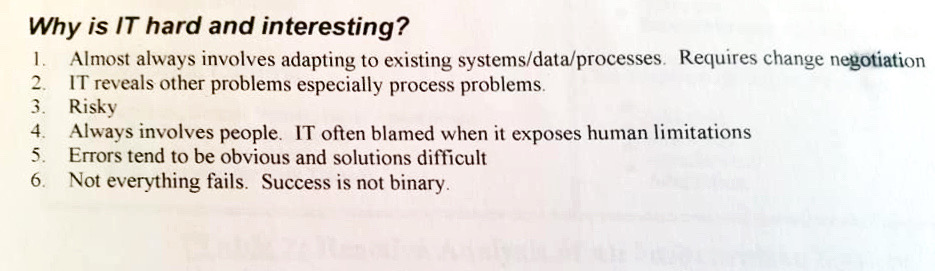
My goodness! All of this is still relevant – why did I throw away my notes?! This is a 20-year-old set of class notes created by an academic who pondered for years to sum up the answer to this question. So this is a good quarter of a century old.
It’s a proof point that the following issues – perception, people, problem solving, change, risk, and the meaning of success seem to be perennial to the we do as professionals in this area. It’s not been solved by all the ‘new’ ways of thinking or by emerging technology but by experience, capability and gumption!
I re-read each one with an eye to refute, to find fault and challenge the basis of the thinking. I sense a hint of bitterness in Point 4, which challenges my Vulcan desire for a flawless fact, however in the end each has a level of simple completeness that I find compelling. Each point could be an essay in its own right – and might develop as such when I find the time. However, there is a risk of falling into a level of self satisfaction – like a drowning man finding comfort in a photo of land. Yes, what we do is hard, and so – it just is hard. People have to accept it and stop asking for so much… and… and… stop judging what you don’t understand! If you leave me alone – I’ll give you what your asking for… without asking you… because you don’t have the skill to ask the right questions…
Sound familiar? As Stantz in Ghostbusters said after losing his academic position, “You don’t know what it’s like in the real world. They expect results!” People don’t do IT or projects for fun – they want a tangible benefit – which is probably about money or service – not technical brilliance.
The point that caught my eye was number 6: Not everything fails. Success is not binary. It relates to a very common project interview question: “What percentage of your projects are a success?”. On 4PM.com Dick Bellows states that 70% of all projects ‘fail’. McKinsey’s website asserts that 17% of IT projects fail so badly they threaten the organisation’s existence. But what is success? I’ve had programs of work that have achieved very positive results and on some projects.. less so. There is much that I’m proud of – and yet I often rethink the projects I would have done differently. It seems to be human nature to focus on the negative. A little article I’ve had in my kit bag for a while is called “Praise is Fleeting, Brickbats we recall“…. it demonstrates our negative bias and our need to find fault. It also recommends maintaining a ‘kudos file’ where you keep all the good stuff, a personal fan club that’s accessible at a moment’s notice. That’s nice – but how about we think a little more deeply, interrogating our expectations and definitions of ‘success’?
Let’s not frame our ideas of success in oversimplified, binary terms. Much of my work has been in project recovery, spotting and sorting out the troubled initiative. Although these are classed as ‘failed’ projects, they turn into something else: over-scheduled, over-budget projects are re-baselined and delivered; dysfunctional teams meet milestones; business expectations change and goals are achieved; investment may stop, with the project winding up and returning the balance of the budget for alternative investment. Something is achieved – even if it is not what the initial business case describes .
One of my favorite projects stopped half-way through. I was working on a flagship Agile project when the Global Financial Crisis hit. Three sprints in on an eight-sprint project, the steering committee called us in and halted the project. So we petitioned for approval to complete the current sprint and implement – we got two week’s grace and closed out successfully. With that stage implemented, the project officially wrapped up and we all headed off in search of new work. We had delivered some of the initial project work and lived the Agile dream. Is it failure? Well, we didn’t achieve our objectives – we were stopped. Is it a success? Darn tootin’! We were practicing Agile methodology in a bank that took another seven years to try it again seriously. We followed the method and reaped the benefit of implementation. I learnt from an amazing team of some of the best in the business (you know who you are – respect!).
So I re-read the dot points of my colleague’s study notes again, reflecting on a refined theme – Perception and problem solving. It’s a little under the body of the text but it’s there and it rings true with all that we do. We solve problems imaginatively; we think through the knots and snares. Importantly, we manage perception, not to obscure the truth, but to rather to bring out the opportunity and potential, to combat negative bias with a message of hope and plans that bring true success.

Copyright 2020 Wintergarten Consulting PTY LTD. All rights reserved. May not be reproduced without written permission.
 Wintergarten Consulting